
Battery Digital Product Passport Requirements
Which batteries need an EU Battery Passport from 18 February 2027, what data it contains, who can access it and what businesses can prepare now.
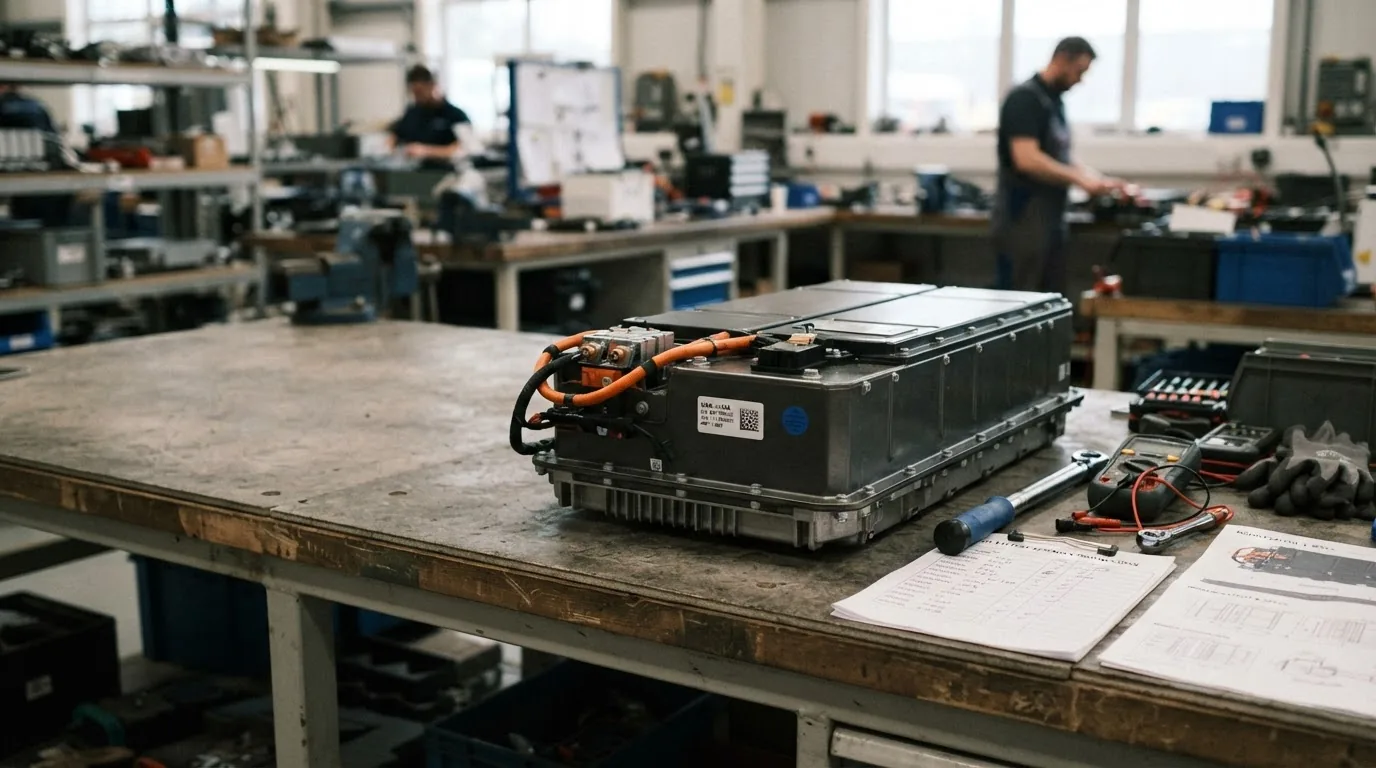
In 60 seconds
The EU Battery Passport is an adopted legal requirement under Regulation (EU) 2023/1542. From 18 February 2027, each light means of transport (LMT) battery, each industrial battery with a capacity greater than 2 kWh and each electric-vehicle battery placed on the EU market or put into service must have an electronic battery passport.1
- Applies from 18 February 2027, adopted, under Regulation (EU) 2023/1542.
- In scope: light means of transport batteries, industrial batteries above 2 kWh and electric-vehicle batteries.
- One passport, carrying model-level information and information about the individual battery.
- Four access classes under Annex XIII, from publicly accessible to legitimate interest only.
- The Article 77(9) access implementing act was not identified as adopted as at 1 September 2026. The roadmap places it in Q4 2026, indicative.
The Battery Passport is unusually detailed. It combines information about the battery model with information specific to the individual battery, including data generated during use. It also separates information by access class. Some information is public, some is reserved for authorities and notified bodies, and some is available only to actors with a legitimate interest.1
That makes the Battery Passport the clearest adopted example of a rich Digital Product Passport. It does not make it the template for every other DPP regime.
For the cross-category position, see Digital Product Passport Requirements by Product Category.
Jump around this page
- In 60 seconds
- Which batteries need a Battery Passport?
- When does the Battery Passport apply?
- What information does the Battery Passport contain?
- Which identifiers and QR code does a Battery Passport carry?
- Is the Battery Passport model-level or item-level?
- Who can see what?
- Where is Battery Passport data stored, and for how long?
- Required under other parts of battery law, not automatically
- What battery businesses can prepare now
- What the Battery Passport shows about DPPs
- Open questions and implementation pending
- Direct questions
- How we know
- Primary and official sources
Which batteries need a Battery Passport?
Regulation (EU) 2023/1542 applies broadly to all categories of batteries, but the Battery Passport obligation in Article 77 is narrower.
From 18 February 2027, a passport is required for:
- LMT batteries, including batteries used in light means of transport such as many e-bikes and e-scooters
- industrial batteries with a capacity greater than 2 kWh
- electric-vehicle batteries.1
The passport rule does not simply mean that every portable, SLI or smaller industrial battery needs the same passport.
The legal trigger: Article 77 applies to covered batteries placed on the market or put into service from 18 February 2027.1
Scope in practical terms
So a battery business should classify the finished battery before building passport logic. The first questions:
- What legal battery category does the finished battery fall into?
- If it is an industrial battery, is capacity greater than 2 kWh?
- Is the battery being placed on the EU market or put into service from the application date?
- Which information requirements apply to that battery category and to the underlying substantive obligation?
Do not use the presence of a QR code, a serial number or a product's commercial label as a substitute for the legal category test.
When does the Battery Passport apply?
The key dates are different legal events, not one generic "DPP deadline".
| Milestone | Date | What it means |
|---|---|---|
| Batteries Regulation adopted | 12 July 2023 | Regulation (EU) 2023/1542 was adopted. |
| Regulation published | 28 July 2023 | Publication in the Official Journal. |
| Battery Passport access-rights implementing act statutory deadline | 18 August 2026 | Article 77(9) required the Commission to adopt the detailed legitimate-interest access act by this date. As at 7 October 2026 it remained pending. |
| Commission updated Battery Passport data-point guidance | 21 August 2026 | Official implementation guidance organised 71 data points by category. It does not create new legal requirements.3 |
| Battery Passport becomes mandatory | 18 February 2027 | Covered LMT, industrial >2 kWh and EV batteries placed on the market or put into service require a passport.1 |
The 18 February 2027 date is law. The Commission's current Q4 2026 timing for the still-pending battery access-rights implementing act is an indicative implementation timetable, not a new statutory deadline.4
For the rest of EU product law, see which EU product rules apply now and which start later.
What information does the Battery Passport contain?
Article 77 and Annex XIII create a hybrid information model. Some information is about the model. Some is specific to an individual battery and can change during the battery's life.
The table below groups the legal requirements into useful information territories. It is not a substitute for the Regulation and should not be read as saying every listed data point is populated in exactly the same way for every covered battery on day one.
| Information territory | What the law establishes | Level | Access | Legal basis |
|---|---|---|---|---|
| Battery identity | Battery model and battery-specific identity, linked to a unique identifier | Model + individual relationship | Mixed | Article 77; Annex XIII |
| Manufacturer and manufacturing | Manufacturer information and the geographical location of the battery manufacturing plant are among the referenced battery information | Model | Mainly public where in Annex XIII Part 1 | Annex VI Part A; Annex XIII |
| Basic technical characteristics | Battery category, manufacture date, weight, capacity and battery chemistry | Model | Public where applicable | Annex VI Part A; Annex XIII Part 1 |
| Hazardous substances and critical raw materials | Substance and critical-raw-material information specified by the Regulation | Model | Public at the level specified; detailed composition is restricted | Annex VI Part A; Annex XIII Parts 1-2 |
| Material composition | Chemistry and composition information, with more detailed cathode/anode/electrolyte composition restricted | Model | Public + legitimate-interest restricted | Annex XIII Parts 1-2 |
| Carbon footprint | Carbon-footprint information where the underlying Article 7 requirements apply to the battery concerned | Model | Public | Article 7; Annex XIII Part 1 |
| Recycled content | Recycled-content information where the underlying Article 8 requirements apply | Model | Public | Article 8; Annex XIII Part 1 |
| Responsible sourcing | Information linked to the applicable battery due-diligence/responsible-sourcing requirement | Model | Public where applicable | Article 52; Annex XIII Part 1 |
| Performance and durability | Rated capacity, voltage, original power and relevant lifetime/performance information | Model | Public where applicable | Article 10; Annex XIII Part 1 |
| Dismantling and repair | Detailed composition, part numbers and spare sources, exploded diagrams, disassembly sequence, fastenings, tools, warnings and cell layout | Model | Legitimate-interest restricted | Annex XIII Part 2 |
| Test evidence | Results of test reports proving compliance | Model | Notified bodies, market surveillance authorities and Commission | Annex XIII Part 3 |
| State of health and status | State of health and status such as original, repurposed, re-used, remanufactured or waste | Individual battery | Legitimate-interest restricted | Annex XIII Part 4 |
| Use and lifecycle events | Cycle counts, negative events and periodically recorded operating/environmental information | Individual battery | Legitimate-interest restricted | Annex XIII Part 4 |
A field can be in the schema without being populated in every case on 18 February 2027
Annex XIII references information that depends on other substantive provisions of the Batteries Regulation. Carbon-footprint, recycled-content and other sustainability obligations have their own scopes, staged application dates and secondary-law dependencies.
So there are two separate questions:
- Is this information territory part of the Battery Passport legal architecture?
- Is this exact value legally required to be populated for this battery category at this point in time?
The Commission's August 2026 guidance organises this complexity by battery category and marks data points as mandatory, optional, conditional or not needing to be filled or displayed as of February 2027.3
That document is Commission guidance. It is not legislation and it expressly says it does not introduce additional legal requirements or provide an authoritative interpretation of the law.3
In the working set we hold for an industrial battery over 2 kWh, there are 32 mandatory rows once conditional and deferred rows are taken out of the count.
Which identifiers and QR code does a Battery Passport carry?
The Battery Passport is a category where the law is specific about the carrier.
Article 77 requires the passport to be accessible through the QR code referred to in Article 13(6). The QR code links to a unique identifier attributed to the battery by the economic operator placing it on the market. Article 77 also requires the QR code and unique identifier to comply with the ISO/IEC 15459 series named in the Regulation, or equivalent standards where the law provides for that possibility.1
From 18 February 2027, Article 13(6) also requires all batteries to carry a QR code, although what that QR code provides access to depends on the battery category. For the Battery Passport categories, it provides access to the passport.1
Three distinctions matter:
- The unique identifier is not automatically the same thing as a GTIN.
- The QR code is the data carrier, not the passport itself.
- Battery law specifying a QR code does not mean every other DPP regime must use a QR code.
For the cross-category identifier question, use Barcodes and Product Identifiers: What You Need.
For EV batteries, see what EN 18060:2025 changes for conformity evidence and what it leaves alone.
Is the Battery Passport model-level or item-level?
Neither description is complete on its own.
Article 77 says the passport contains:
- information relating to the battery model
- information specific to the individual battery
- including information resulting from the use of that battery.1
That makes the Battery Passport a hybrid model + individual/lifecycle architecture.
This distinction is more important than calling the passport simply "item-level". A battery producer needs a data model that can separate stable model truth from changing individual-battery data.
There is also lifecycle continuity. If a battery is prepared for re-use, repurposed or remanufactured, the Regulation requires a new passport linked to the original passport or passports. The battery passport ceases to exist after the battery has been recycled.1
For the wider comparison, see Model, Batch or Item Level for a Textile Passport.
Item-level identity keeps working after sale
An item-level passport only helps if the individual battery stays identifiable through its systems, its service history and any change of status. Your first product identifier covers choosing identifiers by level, and what a product code can do after the sale covers how that identity keeps routing people to the right service later.
Who can see what?
Battery law is the strongest current example of why "DPP data is public" is too broad.
Article 77 and Annex XIII provide three broad access classes.
General public
Annex XIII Part 1 covers the model information made accessible to the general public. This includes a wide range of identity, technical, sustainability, performance and end-of-life information where applicable.1
Notified bodies, market surveillance authorities and the Commission
Annex XIII Part 3 reserves test-report results proving compliance to notified bodies, market surveillance authorities and the Commission.1
Persons with a legitimate interest
Annex XIII Parts 2 and 4 cover commercially and operationally sensitive information for legitimate-interest actors. Examples include:
- detailed cathode, anode and electrolyte composition
- component part numbers and replacement-spare sources
- detailed dismantling information
- safety measures
- individual performance and durability values
- state of health
- battery status
- charging/discharging cycles
- negative events
- operating conditions and state-of-charge information.1
Article 77 links legitimate-interest access to purposes such as repair, remanufacturing, second-life operations and recycling, or certain purchaser/energy-market purposes.
The unresolved access-rights point
Article 77(9) required the Commission to adopt an implementing act by 18 August 2026 specifying which persons qualify as persons with a legitimate interest, what information they can access and the extent to which they may download, share, publish and re-use it.1
As at 7 October 2026, no such adopted implementing act was identified in the current primary-source verification. The Commission's DPP implementation page still places the Battery access-rights implementing act in Q4 2026 and labels the timeline indicative. The Commission's Battery Passport FAQ says a draft is expected for public feedback on Have your say in October or November 2026.4
So the law already establishes the access architecture and Annex XIII data classes, but a material part of the detailed legitimate-interest access implementation remains pending.
See Who Can See What in a Digital Product Passport for the cross-category access question.
Where is Battery Passport data stored, and for how long?
The Battery Passport should not be described as a record fully stored inside one central EU database.
Article 78 requires passport data to be stored by the responsible economic operator, or by an operator authorised to act on its behalf. It also sets requirements for interoperability, free access according to rights, persistence, controlled modification, data reliability, security and privacy.1
Article 77(10) requires the economic operator placing the battery on the market or putting it into service to upload the unique identifier to the DPP Registry established under ESPR.1
The EU DPP Registry became operational on 20 July 2026.5 Its role is a regulatory registration and discovery/enforcement layer. It is not the full central store of every battery passport data point.
What the Registry can and cannot do for a Battery Passport today
Batteries are the first product group the Registry exposes, but as checked on 7 October 2026, User Guide v1.03 says successful Battery DPP registration is not currently available because the Battery semantic catalogue and content have not yet been defined, and it offers only item level, an interface state that says nothing about what battery law will finally require. Enrolment and the separate Registry test environment let you rehearse how to register a DPP in the EU Registry now; the DPP Registry & Operational Infrastructure snapshot holds the current position.
Required under other parts of battery law, not automatically a universal DPP field
The Battery Passport pulls together information connected to several substantive requirements elsewhere in the Batteries Regulation.
That does not turn those requirements into universal DPP fields for other products.
Examples include:
- battery-specific carbon-footprint obligations
- battery-specific recycled-content obligations
- battery due-diligence/responsible-sourcing information
- battery performance and durability requirements
- battery markings and end-of-life information.
The Batteries Regulation deliberately connects these battery-law obligations to its own passport architecture.
What battery businesses can prepare now
PREPARE
Confirm legal battery category and capacity. Build the scope decision before the passport workflow.
Separate model data from individual-battery data. The legal architecture requires both.
Create stable battery identity. Plan for the unique identifier and its relationship to the mandatory QR carrier.
Structure the adopted Annex XIII territories. Map existing sources for manufacturer, manufacturing plant, chemistry, technical characteristics, performance, composition, sustainability and end-of-life information.
Prepare lifecycle data governance. Define who can update state-of-health, status, use-event and other changing data.
Prepare evidence provenance. Link claims and values to source documents, test evidence and the legal obligation they support.
Plan for restricted access. Do not publish the legitimate-interest or authority-only data as if Annex XIII made it public.
WATCH
- adoption of the Article 77(9) Battery access-rights implementing act
- any further revisions to the Commission's Battery Passport data-point guidance
- changes to the category-by-category February 2027 applicability of individual data points
- delegated or implementing acts underpinning carbon, recycled-content and other referenced obligations
- DPP standards and service-provider implementation changes.
IMPLEMENTATION DETAIL STILL PENDING
The most material open point at 7 October 2026 is the detailed implementing act for legitimate-interest access rights.
That is an implementation dependency, not a reason to treat the whole Battery Passport as uncertain. Scope, the 18 February 2027 application date, the hybrid model/individual architecture and the Annex XIII information classes are already in adopted law.
ActivateDigital does this part as a governed Battery Passport record built from the documents you already hold, and says which of the mandatory fields your evidence currently covers.
Implementation status as of September 2026
The legal Battery Passport start date has not moved: 18 February 2027 remains the controlling date for the covered battery categories.
What has changed is how much of the implementation stack can now be tested.
| Status on 6 September 2026 | What it means |
|---|---|
| EU DPP Registry operational | Registry integration is no longer only a future architecture question |
| Six DPP standards cited in the Official Journal | Several horizontal technical implementation areas now have cited standards |
| Commission Battery Passport guidance published | Businesses have a current non-binding 71-point preparation aid |
| BatteryPass-Ready longlist/data model v2.0 and test resources available | Teams have practical mapping and testing tools, but these are not controlling law |
| Battery access-rights implementing act still shown for Q4 2026 | Detailed legitimate-interest permission policy remains a moving dependency |
| Two remaining DPP standards still on the Commission's September 2026 timetable | Do not describe the full standards package as final yet |
The implementation response is to separate the stable core from the moving edge. Build identity, governed data, evidence provenance, lifecycle handling and Registry integration against what is already settled. Keep unresolved access policy and dependency-sensitive validation configurable.
For the dated sequence of what to implement, test and retain as evidence, see Battery Passport 2027 readiness.
What the Battery Passport shows about DPPs
The Battery Passport demonstrates a hybrid model + individual lifecycle passport.
Detergents and toys, although also adopted DPP regimes, use a model-level default and very different information structures.
The broader lesson is not "copy the Battery Passport". It is:
Build a flexible product-data system around the verified requirements of the relevant category.
See Digital Product Passport Requirements by Product Category for the wider architecture.
Battery Passport and vehicle DCVP are separate passports
An EV battery can require its own Battery Passport from 18 February 2027, years before the vehicle-level Digital Circularity Vehicle Passport applies from 1 September 2032.
The two passports represent different regulated objects. The Battery Passport belongs to the covered battery under Regulation (EU) 2023/1542. The DCVP belongs to the in-scope vehicle under Regulation (EU) 2026/1738.
The vehicle law nevertheless requires the DCVP to interoperate with the Battery Passport. Where required information is already accessible through the interoperable Battery Passport, it should not be duplicated in the DCVP. The exact technical link between the two passports is still part of the later DCVP implementation layer.
For the vehicle-level rule, see EU Digital Circularity Vehicle Passport (DCVP): What Changes for Cars and Vans from 2032?
Open questions and implementation pending
As at 7 October 2026:
- The Article 77(9) legitimate-interest access implementing act is overdue against its statutory 18 August 2026 deadline and remains pending in the Commission's implementation timetable.
- The Commission's 71-data-point guidance may continue to evolve and should not be treated as law.
- Some information referenced by Annex XIII depends on category-specific or staged substantive obligations and secondary measures.
- Wider DPP standards, Registry and service-provider implementation will continue to affect technical delivery without changing the basic Battery Passport scope.
Direct questions
Which batteries need a Battery Passport?
From 18 February 2027, each LMT battery, each industrial battery above 2 kWh and each EV battery placed on the market or put into service must have a Battery Passport.1
Is the Battery Passport item-level?
It includes individual-battery information, but it is better described as a hybrid model + individual/lifecycle architecture because Article 77 requires both model information and information specific to the individual battery.1
Is Battery Passport information public?
Not all of it. Annex XIII separates public data from authority/notified-body data and legitimate-interest data.1
Does a Battery Passport require a QR code?
Yes for this regime. Article 77 links the passport to the battery through the QR code required by Article 13(6).1 That does not make QR a universal rule for every DPP category.
Does a Battery Passport require carbon-footprint information?
Carbon-footprint information is part of the Battery Passport architecture where the underlying Article 7 obligation applies. The exact population requirement depends on the battery category and the relevant staged legal obligation.13
What are the 71 Battery Passport data points?
The Commission's 21 August 2026 guidance organises 71 data points across covered battery categories. It is implementation guidance, not a new legal field list created independently of the Batteries Regulation.3
How we know
The access-rights position on this page was rechecked on 7 October 2026. The other material claims were checked against current EU primary and official sources on 1 September 2026. The legal rule comes first. Commission implementation guidance is used only as guidance and is labelled as such.
Keep exploring
The questions this page usually raises next.
Primary and official sources
-
EU law
-
EU law
-
European Commission
-
European Commission
-
European Commission
-
European Commission
https://single-market-economy.ec.europa.eu/single-market/digital-product-passport/batteries_en
Does this reach your products?
ActivateDigital builds the battery record from the documents you already hold, and says which of the 32 fields in our battery model your evidence answers.