
What Changes When Product Identity Becomes a Join Key for External Data?
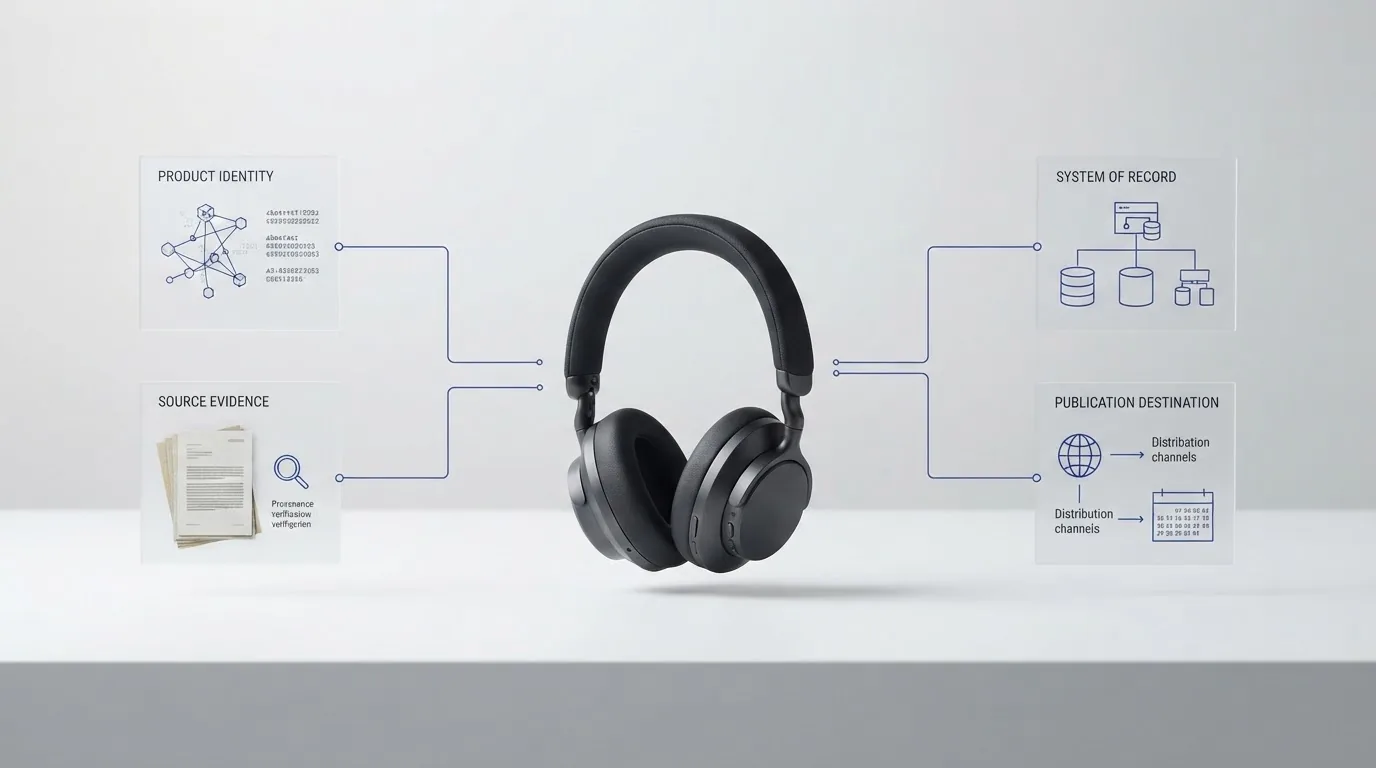
See how stable product identity can join weather, recall, retailer, market and rule data to make contextual decisions without turning the passport into a giant database.
Jump around this page
- In 60 seconds
- Product data is not the same as decision context
- Using identity as a join key
- Five worked examples
- What makes an external-data join trustworthy?
- Where should the decision happen?
- What could this become?
- What should not be automated?
- What this means for businesses now
- Maturity as at 4 September 2026
- What would change this answer?
- Keep exploring
- Primary sources
In 60 seconds
A stable product identity does not need to contain every fact that could ever matter. It can act as a join key: software identifies the product, fetches the outside context needed for the decision, applies an explicit rule or model and then takes a bounded action.
- W3C Geolocation describes the hosting device. A browser scan location does not prove the physical product was there.
- A recall join should query the authoritative recall source for the market. A software rule is not itself the legally authoritative recall source.
- CARFAX History-Based Value uses a VIN to join history, market and location factors into an item-specific value. That is NOW in vehicles.
- A credential that verifies under W3C Verifiable Credentials 2.0 does not prove the claim is true or legally sufficient.
- As at 4 September 2026, reusable cross-sector context services are EMERGING and a general version that works across product categories is POSSIBLE.
So the design question shifts from putting more data in the product record to joining the right outside context at the moment of decision.
Weather, market prices, retailer stock, local service availability, recall status and jurisdiction can all change what should happen to a product without becoming permanent product facts themselves.
The technology for these joins exists NOW. Bounded versions are already deployed in vehicles, retail, traceability and ordinary API-driven software. What is still EMERGING is a reusable cross-sector layer that treats product identity as the stable anchor and manages context, provenance, freshness and decision logic consistently.
Treat the product identity as the join key, not the container. Keep governed product facts, external context and decision outputs distinct.
Product data is not the same as decision context
A product record answers questions such as:
- what product is this?
- which model, lot or item does the identifier refer to?
- what governed attributes are attached to it?
- which current resources or services can software resolve from that identity?
A decision often needs more.
A logistics team may need the weather at the relevant place and time. A retailer may need current stock or channel availability. A recall workflow may need an authoritative recall source and the market in which the item is being used. A valuation service may need transaction prices and local demand. A claims workflow may need the applicable jurisdiction and the rule version in force when the decision is made.
Those are contextual inputs, not automatically product facts.
That distinction protects both architecture and meaning. If every outside fact is copied into a passport, the passport becomes harder to govern, freshness becomes unclear and source ownership is blurred. If the product identity remains stable and software joins to current external sources when needed, each system can retain responsibility for the data it owns.
The existing question of which system should own each product fact remains separate. This article owns what happens when the decision depends on information outside those governed product facts.
Using identity as a join key
Identify the product at the level the decision needs and join only the outside context that decision requires. Check where each input came from, when it was observed and what it covers. Decide with a rule you can inspect. Then measure the outcome against a denominator that makes the result interpretable.
GS1 Digital Link and the GS1-Conformant Resolver Standard provide current mechanisms for turning a stable GS1 identity into one or more linked resources. The resolver can expose different resource types while the identifier remains stable. That is useful infrastructure for these joins, but it does not make the decision.
The same separation appears in the wider product-action stack. A product identifier can help software discover an action, but discovery does not establish whether the external data is trustworthy, whether the rule is correct or whether the caller is authorised to act.
Five worked examples
The value becomes clearer when the decision is named precisely.
Location, time and weather
Suppose a product is believed to have passed through a location at a particular time. Software can join that observation to weather, flood, heat, fire, route or other GIS data and ask whether the external conditions justify inspection, rerouting or a maintenance check.
This is technically composable NOW in bounded logistics and industrial systems.
External weather is evidence about the context around the observation. It is not proof that the product itself experienced a specific temperature, humidity level, shock or exposure.
The location input also has to be described honestly. The W3C Geolocation specification exposes the location of the hosting device. If somebody scans a product code in a browser and permits geolocation, that creates evidence about the scanner or device location. It does not automatically prove that the physical product was at those coordinates.
Where the decision depends on actual condition, direct sensing may be required. That deeper question belongs to what changes when a product can report its condition.
Recall status
A product does not need a copy of every recall database inside its passport.
Instead, software can use the product or lot identity as the anchor, query the appropriate authoritative recall source for the relevant market and decide whether the unit falls inside the affected scope.
This pattern is NOW in bounded regulated and traceability systems, although the exact identifiers, databases and granularity differ by sector.
The key design question is whether the external recall source can match the identity level actually available. If the recall is lot-specific and the system only knows a model-level identifier, software should not manufacture item-level certainty. The identity-granularity decision is owned by lot, serial and item-level operational identity, while the operational recall journey is covered in what happens to a DPP after a product recall.
Software can make the join and expose the reason for the result. It should not pretend that a software rule is itself the legally authoritative recall source.
Retailer stock, price and channel
The product record may correctly describe the product while a commercial route has changed since the record was published.
A retailer may be out of stock. A service may only be available in selected markets. A channel may no longer carry a variant. A current price or offer may exist only behind a retailer or account system.
This is ordinary API-driven software and is technically NOW.
The architectural point is not that retailer data should become part of the DPP. It is that stable product identity can connect governed product information to current commercial state at the moment a user or system needs it.
Commercial terms, stock feeds, account-specific prices and retailer data remain owned by the relevant channel. The DPP and the retailer feed also remain different objects, as explained in can a DPP replace a retailer product feed?.
History and market value
Vehicles provide one of the clearest deployed demonstrations of the join-key principle.
CARFAX History-Based Value uses a VIN to connect one vehicle to history and market factors rather than valuing it only as an abstract make and model. CARFAX describes factors including service and accident history, ownership, recalls, condition, location and market information. Its lender product applies that value to lending, loan-to-value and remarketing decisions.
That is NOW in vehicles. It does not establish that every product category has the data density, market liquidity or trusted history required to do the same thing.
The broader value question belongs to can a product's history change what it is worth?. The point here is architectural: the market data does not have to live inside the item record. The item identity makes the join possible.
Claims and evidence
A future claims system could join a governed product claim to its evidence, the relevant jurisdiction and the rule version that applies at the time of publication or review.
The technology components can compose today. W3C Verifiable Credentials 2.0 provides machine-verifiable credential primitives that can help a system establish issuer, integrity and status.
That still does not make the final legal decision automatic. A valid credential does not prove that the underlying claim is factually true, that the issuer is authoritative for every purpose or that the evidence is legally sufficient in the relevant jurisdiction. Those boundaries are explored in what a machine-verifiable product certificate actually proves.
So a general cross-sector machine claims engine is better treated as EMERGING/POSSIBLE architecture with human review for consequential decisions, not as a mature autonomous legal authority.
What connected identity can unlock beyond compliance
Persistent product identity becomes useful when the same product can be recognised outside the system where its record was created. That can support product-data syndication, AI-mediated shopping, product-level measurement, correction, recall, repair and other services. Shopify can remain a valid source in that architecture; the Shopify guide explains the boundary.
None of those outcomes comes from the identifier alone. Identity is the join. The value comes from what reliable systems can do once they agree which product they are talking about.
If identity already connects governed product information and services, the passport should not become another isolated database. Continue to the product data you already have and which of it a passport can use.
What makes an external-data join trustworthy?
The join itself is usually the easy part. The difficult work is preserving the meaning of each input.
For each outside input, keep track of whether it describes the same product, lot or item, where it came from, how current it is, which place and rules it applies to and whether you have the right to use it. That stops a join from silently becoming a claim that all inputs are equally authoritative.
It also makes later audit possible. If a decision changes because a retailer feed was stale, a rule version changed or a location observation was weak, the system should be able to show that rather than simply displaying a different outcome.
Where should the decision happen?
There is no architectural reason for every contextual decision to happen inside the DPP itself.
Product facts, outside context, the rules that decide and the systems that act can stay in separate places, joined through the product identity. That is closer to a decision service built around product identity than a bigger passport database.
The architecture also lets different decisions use different context. A warranty decision may need condition history and entitlement. A recall decision may need lot identity and jurisdiction. A resale decision may need history and market data. A service-routing decision may need location and provider availability.
The stable identity is reusable. The context is decision-specific.
What could this become?
The individual components are not speculative. Stable identifiers, resolvers, APIs, event stores, rules engines and external datasets all exist. Bounded vertical systems already prove that these pieces can create operational decisions.
What's missing is a reusable layer between them, so each new use case doesn't need its own bespoke integration. That cross-sector packaging is EMERGING. A general version that works across product categories is still POSSIBLE, not an established industry layer.
What should not be automated?
External context can improve a decision without being strong enough to make that decision alone.
Do not automatically treat:
- scanner location as proof of product location;
- weather near an observation as proof of exact product exposure;
- a signed credential as proof that a claim is true or legally sufficient;
- a market model as a universal statement of value;
- a risk score as proof of fault, fraud or counterfeit;
- an API response as legally authoritative simply because it is machine-readable;
- identity as proof of ownership, entitlement or permission.
High-impact decisions should have explicit review or escalation rules when the evidence is incomplete, contested or outside the model's validated scope.
The same is true of measurement. A workflow may technically fire, but that does not show business value. Use the existing guidance on testing whether product information changes a business outcome and choosing the right denominator before claiming impact.
What this means for businesses now
You do not need to wait for a universal Digital Product Passport architecture to use product identity as a join key.
Start with one decision where external context changes the next action.
Define the product identity required. Name the external source. State which system owns it. Record its freshness and jurisdiction. Write the decision rule in a form that can be inspected. Decide what happens when the source is missing or contradictory. Then measure whether the resulting action improves the intended operational outcome.
The useful question is not:
What other data can we put in the passport?
It is:
What decision are we trying to make, which product identity anchors it and which external context is necessary at the moment of decision?
That shift is small in software terms, but important in product architecture. It turns persistent identity from a pointer to static information into a controlled way of assembling the context needed to decide what should happen next.
Maturity as at 4 September 2026
- NOW: product identifiers can resolve to machine-readable resources and can be used as join keys into external APIs, databases and decision services.
- NOW, bounded: vehicles, retail, traceability and other vertical systems already combine identity, history or external context to produce operational decisions.
- EMERGING: reusable cross-sector context services that keep product facts separate from external decision context while preserving provenance and freshness.
- POSSIBLE: a general context service that works across product categories.
- NOT SUPPORTED: all useful external data belongs in the DPP, a joined value is automatically trustworthy, scanner location proves product location, external context proves causality or a software result is automatically a legal truth.
What would change this answer?
Revisit this architecture if cross-sector standards emerge for product-context connectors, shared policy semantics or portable decision explanations, or if product-specific DPP rules begin to require external-context joins as part of regulated operational workflows.
The main evidence threshold is not whether software can join two datasets. It already can. The question is whether the join can preserve identity scope, provenance, freshness, rights and decision accountability across organisations.
Keep exploring
The questions this page usually raises next.
- CompareNext questionThe Programmable Product: what becomes possible when physical products can identify, sense, remember and act?
- Evidence behind thisNext questionCan product identity detect clones, diversion or impossible movement?
- CompareNext questionWhat changes when a product can report its condition?
- CompareNext questionCan a product's history change what it is worth?
- CompareNext questionWhat has to be true before an AI agent can act on a specific product?
- Another angleNext questionWhich system should own each product fact?
Primary sources
-
Standards body
-
Standards body
Does this reach your products?
Give ActivateDigital one product and it works out which obligations apply from the product's own character, and says which it cannot decide.