
Can a Machine Verify a Product Certificate, and What Has It Actually Verified?
See what machine verification of a product certificate can establish, from integrity and status to scope, and what it cannot prove about the product.
The short answer
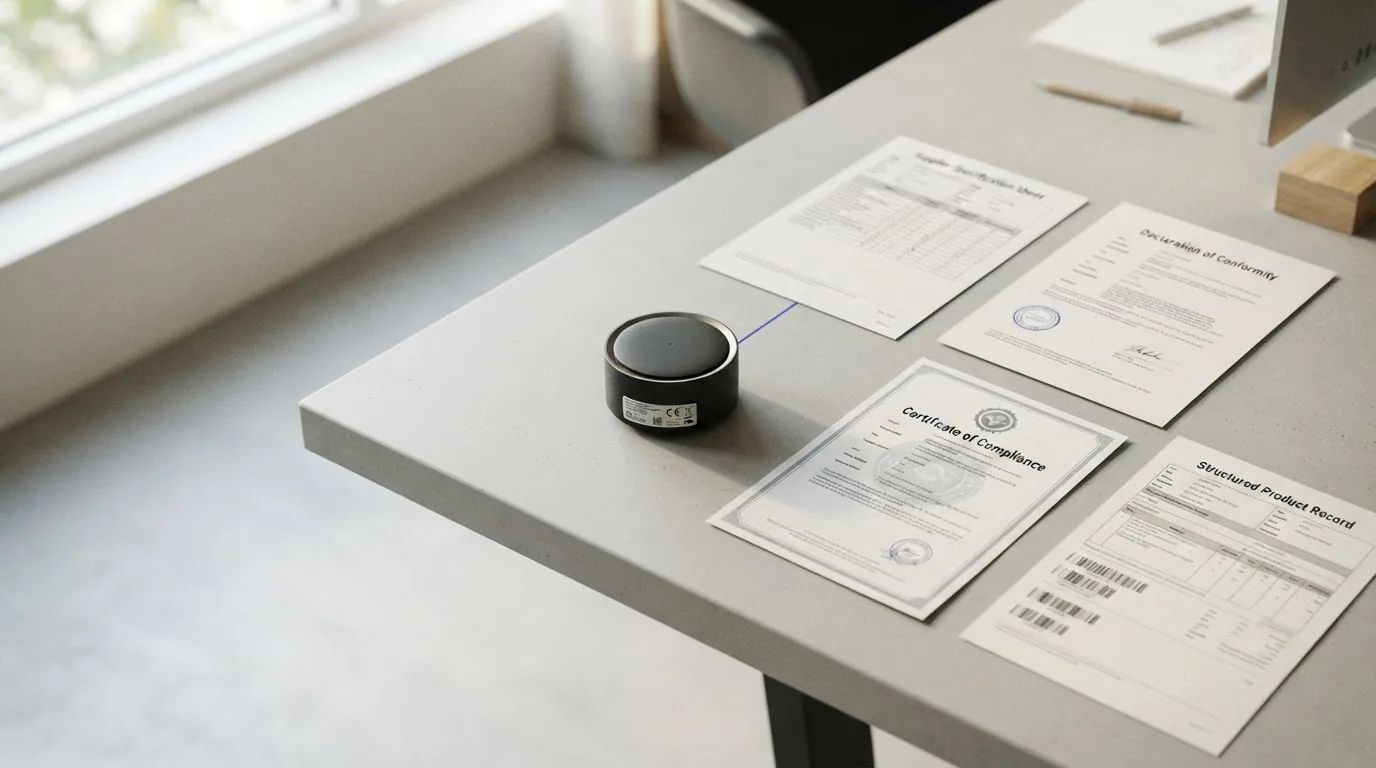
Yes. A machine can verify important properties of a digital certificate or credential: whether its cryptographic proof is valid, who issued it, whether its published status has changed and whether the credential contains the subject and claims a verifier expects. Standards such as W3C Verifiable Credentials Data Model 2.0, Verifiable Credential Data Integrity 1.0 and Bitstring Status List 1.0 provide Recommendation-level building blocks for doing those checks.
That does not mean the product claim is true. It does not prove that the issuer was entitled to certify every asserted scope, that the credential refers to the physical item in front of you or that the underlying test or audit was correct. A machine-verifiable certificate is therefore a stronger evidence object, not an automatic truth machine.
That distinction is the same one behind signing a product record: a valid proof can tell you something important about the record without closing every question about the thing the record describes.
Navigate this page
- The short answer
- The five layers a verifier actually has to separate
- What W3C Verifiable Credentials standardises
- A valid issuer is not enough: scheme, scope and product stil
- Credential verified does not mean claim true
- A machine-verification result worth exposing
- What would change this answer
- Keep exploring
- Sources
The five layers a verifier actually has to separate
“Verified” is too compressed to be a useful status on its own. In practice, there are five different questions.
| Verification layer | What a machine can check | What a pass does not establish |
|---|---|---|
| Integrity and signature | Whether the secured credential has been altered and whether its cryptographic proof validates under the chosen verification method | Whether the claim inside the credential is factually true |
| Issuer identity and authority | Which issuer made the assertion, subject to the identity and trust method being used | Whether that issuer was authorised or competent for every product, scheme and scope asserted |
| Credential status and version | Whether a compatible status mechanism reports the credential as current, suspended or revoked | Why the status changed, or whether the original evidence was correct |
| Claim, scope and subject binding | Whether the credential identifies the expected subject, claim, certificate reference, product or other scoped object | Whether the scope is commercially or legally sufficient for the claim you want to make |
| Physical-product binding | Only what the wider product-identification or authentication system provides | A valid digital credential does not by itself prove that the physical item carrying or presenting it is genuine |
The layers are cumulative, not interchangeable. Passing the first does not automatically pass the fifth. The underlying evidence still has to be understood on its own terms, which is why certificates, declarations and test reports need different evidential treatment.
What W3C Verifiable Credentials standardises
The current ratified baseline is W3C Verifiable Credentials Data Model v2.0, published as a Recommendation on 15 May 2025. It defines roles including issuer, holder, subject and verifier, and a data model through which issuer claims can be secured and evaluated. The related Data Integrity 1.0 Recommendation defines a cryptographic proof model that can make compatible credential data tamper-evident and allow authorship or authenticity checks. Bitstring Status List v1.0, also a Recommendation from 15 May 2025, provides a machine-checkable way to publish status information such as suspension or revocation.
Those standards matter because they make three previously manual questions far easier to automate: was this credential changed, who secured it and what is its current published status?
They do not standardise product certification as a whole. They do not decide whether an issuer is recognised under a particular certification scheme. They do not decide whether a certificate covers this finished product rather than a supplier, process or facility. They do not test the physical object. The W3C model itself leaves verifiers to apply their own business rules after the technical checks.
Version discipline matters too. W3C's VC Data Model publication family shows v2.1 as a Working Draft dated 16 August 2026, while v2.0 remains the Recommendation in the W3C publication record reviewed here. An implementation should therefore pin the normative version and profile it actually supports rather than treating “VC” as a timeless single specification.
Maturity today
| State | What is justified |
|---|---|
| NOW | VC, Data Integrity and status primitives can support machine verification of credential integrity, issuer assertions and status. |
| EMERGING | Product-specific credential profiles and explicit acceptance by regulators or certification schemes. |
| POSSIBLE | Wider consumption by software agents when product binding and trusted-issuer semantics become standardised and interoperable. |
| NOT_SUPPORTED | Treating credential verification as proof of claim truth, physical authenticity or universal issuer authority. |
A Recommendation is a technical standard, not evidence that every product sector has deployed it. A live verification service is a deployment, not evidence that all certificates use the same machine-verifiable model.
A valid issuer is not enough: scheme, scope and product still matter
Existing certification systems show why this distinction is operational rather than theoretical.
OEKO-TEX Label Check allows a third party to enter a label number and check whether an OEKO-TEX label is official. GOTS' Certified Suppliers Database exposes certificate and organisation status but explicitly warns against treating a certified operation as proof that every product it makes or sells is GOTS certified. FSC similarly provides public certificate-holder search. These are scaled examples of scheme-controlled verification infrastructure.
The lesson is not that those schemes are equivalent. It is that certificate state and certificate scope are separate checks.
A machine can receive a technically valid credential from a real issuer and still need to ask:
- Is this issuer recognised for the relevant scheme?
- Is the certificate current for the relevant period?
- Does its scope cover this product, site, process or claim?
- Is the identifier in the credential actually bound to the subject being evaluated?
- Does the proposed product claim stay inside what the scheme certifies?
The European Commission's EUDAMED Notified Bodies and Certificates module is another useful boundary case. It can expose current certificate state and links to manufacturer and Basic UDI-DI references in a regulated medical-device context. That demonstrates that regulator-run, machine-usable certificate-state infrastructure is possible in production. It does not create a generic certificate registry for every product category or prove claims outside the certificate's regulatory scope.
The EU Ecolabel likewise has public-authority-backed catalogue and verification infrastructure. Catalogue presence is useful evidence. It still has to be interpreted against the label's criteria and scope.
If your problem is where a certification can be published so that machines can find it, that is a different canonical question: where a textile certification can actually live in machine-readable form.
Credential verified does not mean claim true
This is the boundary that should survive every interface simplification.
Cryptography can show that a signed or secured record has not been altered in a way that breaks its proof. A status service can show that the issuer currently presents a compatible credential as valid rather than suspended or revoked. A registry can show that a certificate or organisation exists in the scheme's records. None of those checks re-runs the test, re-performs the audit or inspects the physical product.
There are at least three ways a technically valid credential can still be insufficient for the decision in front of you.
The underlying assertion may be wrong. A credential can faithfully preserve a mistaken or poorly supported claim.
The scope may be wrong for the intended use. Entity certification, facility certification, material certification and finished-product certification are not interchangeable merely because the issuer is legitimate.
The digital subject may not be the physical object. A valid record can be copied, re-presented or attached to the wrong item unless a separate authentication mechanism closes that gap. The estate's canonical treatment of that problem is identity, authentication and ownership.
That is why a verification UI that turns all of this into a single green “verified” badge throws away the most useful information.
A machine-verification result worth exposing
ActivateDigital architecture guidance: report the layers independently rather than collapsing them into one binary status.
A useful result might look like this:
| Check | Example output | Interpretation |
|---|---|---|
| Credential integrity | PASS | The secured credential validates under the expected proof method |
| Issuer identity | PASS | The credential resolves to the expected issuer identity under the chosen trust method |
| Issuer authority | CHECK / UNKNOWN | Authority for this particular scheme or scope still needs policy evidence |
| Credential status | PASS | The compatible status source does not report suspension or revocation at the time checked |
| Product/scope binding | CHECK | The product, model, batch, site or other subject needs to match the certificate scope |
| Physical-item authenticity | UNKNOWN | No physical authentication conclusion follows from the credential alone |
The labels are guidance, not a W3C requirement. The principle is the important part: expose what was checked and what remains unresolved.
That becomes even more important when a machine is expected to act rather than merely display the result. A valid credential can contribute to an agent's trust decision, but it is only one part of the permission and action stack described in what has to be true before an AI agent can act on a specific product.
What would change this answer
This page should be revisited if any of the following changes materially:
- W3C VC v2.1 or later work changes the ratified baseline used by product implementations;
- certification schemes publish stable product-specific VC profiles with explicit subject and scope semantics;
- regulators or schemes formally accept machine-verifiable credentials as part of product certification workflows;
- interoperable physical-product binding becomes part of the same verification chain rather than a separate system.
The supporting technology is already real. The unresolved question is how consistently product sectors bind technical verification to scheme authority, product scope and the physical thing.
Keep exploring
The questions this page usually raises next.
Sources
Sources as at 4 September 2026.
Does this reach your products?
Give ActivateDigital one product and it works out which obligations apply from the product's own character, and says which it cannot decide.